US Plant Patent PP18262
Randy
Male Pistachio tree named ‘Randy’
PUBLIC DOMAIN
Patent expired October 17, 2025. This plant is in the public domain — anyone may propagate and sell it.
Twenty years from the filing date would end on March 21, 2025. This patent earned 210 days of term adjustment for delay at the Patent Office, which is why it runs longer.
The record
- Patent number
- PP18262
- Filed
- March 21, 2005
- Granted
- December 4, 2007
- Expires
- October 17, 2025
- Assignee
- UNIV CALIFORNIA
- Inventor
- PARFITT DAN E; MARANTO JOSEPH; KALLSEN CRAIG E
Abstract
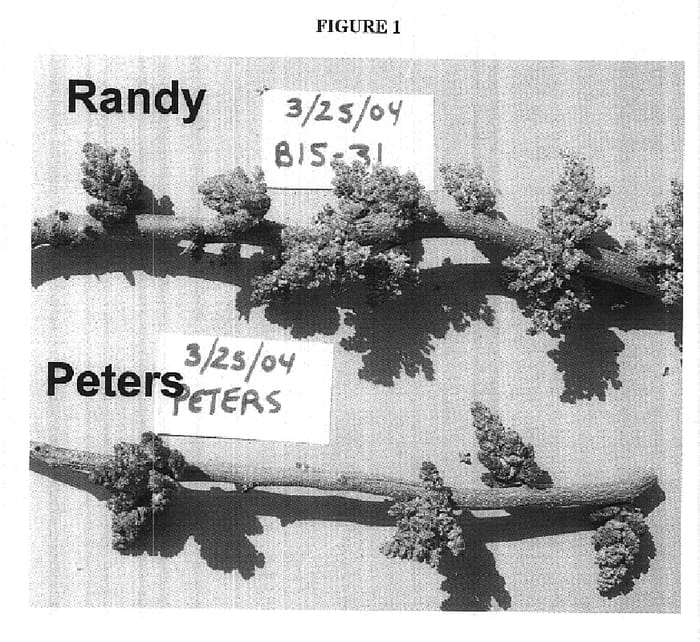
A new and distinct variety of pistachio tree denominated ‘Randy’ is described. This cultivar is an early flowering male that will be used as a pollenizer for ‘Golden Hills’ and ‘Lost Hills’. It has excellent flowering synchrony with ‘Golden Hills’ and ‘Lost Hills’ and can be used to cover the earlier part of the ‘Kerman’ flowering period during seasons in which ‘Kerman’ flowering is extended. This generally occurs during seasons of low chill, which are expected to become more frequent in the future due to continued global warming ‘Peters’, the standard male used to pollenize ‘Kerman’, often flowers too late to cover the earlier part of the ‘Kerman’ bloom period under these conditions. ‘Randy’ was selected for high pollen viability, durability, and a high level of pollen production (based on visual evaluation). ‘Randy’ flowers 2 to 4 weeks earlier than ‘Peters’, the standard pollenizer for ‘Kerman’. ‘Peters’ flowers too late to be a very effective pollinator for the new cultivars.
Show the legal claimThe single numbered claim as granted — the legal text that defines what this patent covers.
1. A new and distinct variety of pistachio tree substantially as shown and described herein.
Read the full patent: US Plant Patent PP18262 in full — the complete specification, every figure, and the file history.