US Plant Patent PP14271
UCMH 56
Mahaleb rootstock named ‘UCMH 56’
PUBLIC DOMAIN
Patent expired December 28, 2021. This plant is in the public domain — anyone may propagate and sell it.
No term adjustment or disclaimer is recorded against this patent, so this is the full statutory term — twenty years from the filing date.
The record
- Patent number
- PP14271
- Filed
- December 28, 2001
- Granted
- November 4, 2003
- Expires
- December 28, 2021
- Assignee
- UNIV CALIFORNIA
- Inventor
- SOUTHWICK STEPHEN M
Abstract
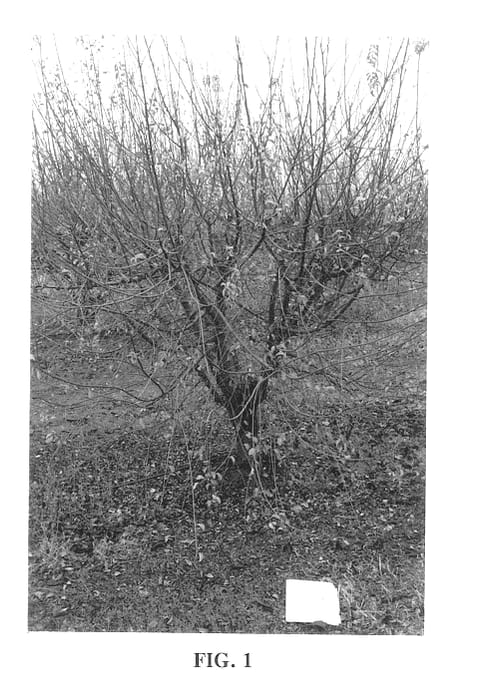
A new and distinct cultivar of Prunus mahaleb is provided. The new cultivar is particularly well suited for serving as an understock during cherry production. A number of advantages are provided when compared to the standard Mahaleb rootstock. The cultivar is readily amenable to vegetative propagation (e.g., by the use of softwood cuttings), and exhibits improved resistance to Phytophthora spp. When used with a 'Bing' cherry scion, increased yields and yield efficiency have been observed without reduced fruit size. Improved precocity in bearing is displayed when compared to the standard Mahaleb rootstock. The new cultivar when grown without use as an understock forms a smaller tree than the 'UCMH 55' cultivar and the standard Mahaleb rootstock. Few suckers are produced.
Show the legal claimThe single numbered claim as granted — the legal text that defines what this patent covers.
I claim: 1. A new and distinct cultivar of Prunus mahaleb plant that exhibits the following combination of characteristics: (a) readily is amenable to vegetative propagation, (b) performs well as an understock for cherry production, (c) forms a smaller tree than the ‘UCMH 55’ cultivar and the standard Mahaleb rootstock, (d) displays improved resistance to Phytophthora spp., (e) makes possible increased ‘Bing’ sweet cherry scion yield and yield efficiency without reduced fruit size when compared to the standard Mahaleb rootstock, (f) demonstrates improved precocity in bearing when compared to the standard Mahaleb rootstock, and (g) produces few suckers; substantially as illustrated and described.
Read the full patent: US Plant Patent PP14271 in full — the complete specification, every figure, and the file history.