US Plant Patent PP16662
Bailina
Lilac plant named ‘Bailina’
PUBLIC DOMAIN
Patent expired July 21, 2025. This plant is in the public domain — anyone may propagate and sell it.
Twenty years from the filing date would end on April 28, 2025. This patent earned 84 days of term adjustment for delay at the Patent Office, which is why it runs longer.
The record
- Patent number
- PP16662
- Filed
- April 28, 2005
- Granted
- June 13, 2006
- Expires
- July 21, 2025
- Assignee
- BAILEY NURSERIES INC
- Inventor
- HOLLAND NEAL S
Abstract
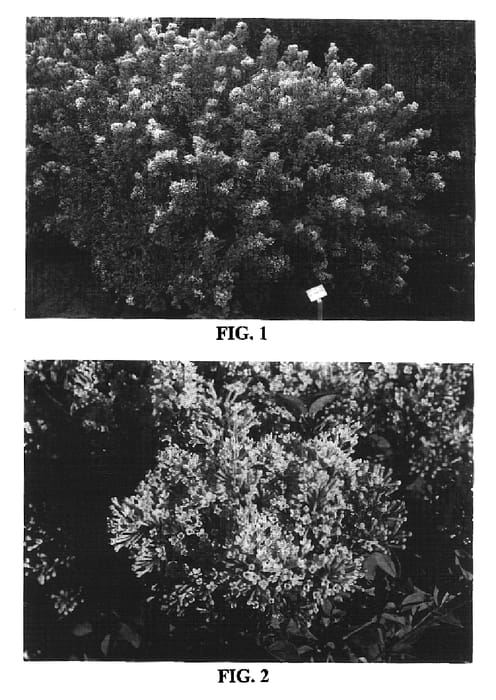
A new and distinct highly ornamental cultivar of Syringa meyeri×Syringa microphylla is provided. A Lilac plant having a generally rounded to oval uniform compact dwarf growth habit is described. Highly attractive densely packed trusses of intensely sweet smelling medium pink buds that open to light pink florets are formed in late spring and subsequently fade to almost white at maturity. Good winter hardiness is made possible and the plant has been found to be relatively free of insect and disease problems during observations to date particularly when grown in full sun in well drained soil. The plant is suitable for growing in U.S.D.A. Hardiness Zone Nos. 4 to 7. The plant is well-suited for growing as an ornamental specimen or as a mass planting in the landscape. The plant also can be grown as a foundation planting or as an informal hedge.
Show the legal claimThe single numbered claim as granted — the legal text that defines what this patent covers.
1. A new and distinct Syringa meyeri×Syringa microphylla plant having the following combination of characteristics: (a) exhibits a generally rounded to oval uniform compact dwarf growth habit, (b) forms in late spring densely packed attractive trusses of intensely sweet smelling medium pink buds that open to light pink florets that fade to almost white at full maturity, (c) is relatively free of insect and disease problems, and (d) is well suited for growing as a distinctive ornamental shrub in the landscape; substantially as illustrated and described.
Read the full patent: US Plant Patent PP16662 in full — the complete specification, every figure, and the file history.