US Plant Patent PP16493
Meivanthou
Hybrid Tea Rose plant named ‘Meivanthou’
PUBLIC DOMAIN
Patent expired August 27, 2019. This plant is in the public domain — anyone may propagate and sell it.
Twenty years from the filing date would end on May 24, 2024, but this patent ends 1,732 days earlier — a terminal disclaimer gives term back. A source that calculates twenty years from filing would tell you this plant is still protected when it is already free.
The record
- Patent number
- PP16493
- Filed
- May 24, 2004
- Granted
- May 2, 2006
- Expires
- August 27, 2019
- Assignee
- C P DELAWARE INC
- Inventor
- MEILLAND ALAIN A
Abstract
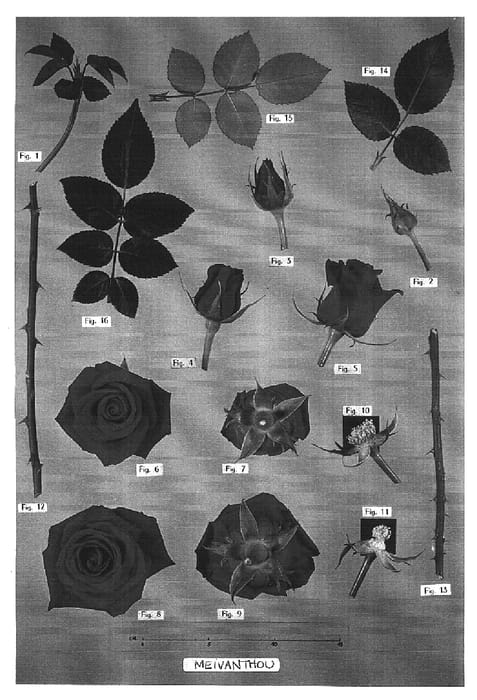
A new and distinct variety of Hybrid Tea rose plant is provided which forms attractive double deep red blossoms with turgescent petals. The buds are large and the blossoms possess no fragrance. The plant exhibits an erect growth habit, and dark green and semi-glossy foliage. Excellent disease resistance particularly with respect to Downey Mildew and Botrytis is exhibited. The new variety is particularly well suited for producing cut flowers under greenhouse growing conditions.
Show the legal claimThe single numbered claim as granted — the legal text that defines what this patent covers.
1. A new and distinct variety of Hybrid Tea rose plant characterized by the following combination of characteristics: (a) forms large floral buds; (b) forms attractive high-centered double deep red blossoms with turgescent petals, (c) exhibits an erect growth habit, (d) exhibits excellent disease resistance particularly with respect to Downey Mildew and Botrytis, and (e) is particularly well suited for the production of cut flowers under greenhouse growing conditions; substantially as herein shown and described.
Read the full patent: US Plant Patent PP16493 in full — the complete specification, every figure, and the file history.