US Plant Patent PP30812
MEIVANAE
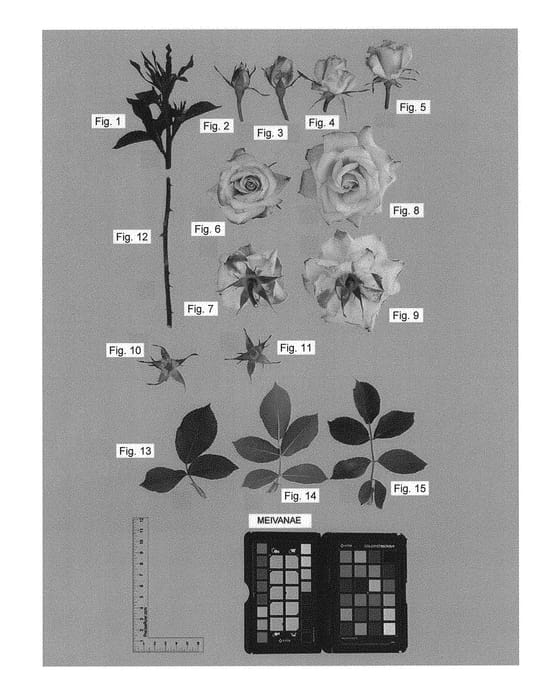
Hybrid tea rose plant named ‘MEIVANAE’
UNDER PATENT
Still under patent. Protection ends April 5, 2038.
No term adjustment or disclaimer is recorded against this patent, so this is the full statutory term — twenty years from the filing date.
The record
- Patent number
- PP30812
- Filed
- April 5, 2018
- Granted
- August 20, 2019
- Expires
- April 5, 2038
- Assignee
- THE CONARD PYLE CO
- Inventor
- MEILLAND ALAIN A
Abstract
A new and distinct variety of Hybrid Tea Rose plant, herein referred to by its cultivar name, ‘MEIVANAE’, is provided which forms abundantly on a nearly continuous basis attractive, cup-shaped, powdery-yellow/orange colored blossoms with a light pink margin which emit a fruity fragrance. Attractive, semi-glossy, very dense foliage is formed, which contrasts beautifully with the blossoms. The disease tolerance is very good; particularly against Black Spot and Oidium. The new variety is well suited for proving attractive ornamentation in the landscape and is very floriferous.
Show the legal claimThe single numbered claim as granted — the legal text that defines what this patent covers.
I claim: 1. A new and distinct variety of Hybrid Tea Rose plant characterized by the following combination of characteristics: (a) abundantly and nearly continuously forms attractive, cup-shaped, powdery-yellow/orange colored blossoms with a light pink margin, (b) forms attractive, very dense, semi-glossy foliage, (c) exhibits very good tolerance to diseases, particularly against Black Spot and Oidium, (d) is very floriferous, (e) emits a fruity fragrance, and (f) is well suited for providing attractive ornamentation; substantially as herein shown and described.
Read the full patent: US Plant Patent PP30812 in full — the complete specification, every figure, and the file history.