US Plant Patent PP20953
Margaret Mae
Climbing rose plant named ‘Margaret Mae’
UNDER PATENT
Still under patent. Protection ends September 14, 2029.
No term adjustment or disclaimer is recorded against this patent, so this is the full statutory term — twenty years from the filing date.
The record
- Patent number
- PP20953
- Filed
- September 14, 2009
- Granted
- April 27, 2010
- Expires
- September 14, 2029
- Assignee
- TOMERLIN REGGIE JOE
- Inventor
- TOMERLIN REGGIE JOE
Abstract
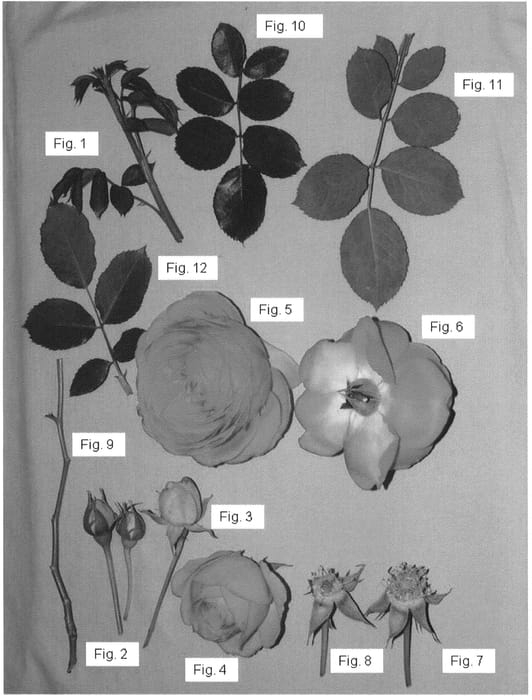
A new and distinct variety of climbing shrub rose plant is provided which forms in abundance on a substantially continuous basis attractive clusters of fully double, deep pink blossoms having approximately 70–80 petals on average. The new variety is a spontaneous mutation of unknown causation of the ‘Meiviolin’ variety (U.S. Plant Pat. No. 6,892). The deep pink color can be readily distinguished from the white-pink color of the ‘Meiviolin’ variety. Vigorous vegetation is formed. The foliage is dense medium green with a semi-glossy finish. Excellent resistance to Black Spot and powdery mildew is displayed. Attractive dense ornamentation in the form of foliage and blossoms is made possible when the new variety is grown on a support.
Show the legal claimThe single numbered claim as granted — the legal text that defines what this patent covers.
1. A new and distinct variety of climbing shrub rose plant characterized by the following combination of characteristics: (a) abundantly forms on a substantially continuous basis attractive clusters of fully double blossoms that are deep pink in coloration, (b) exhibits an upright climbing growth habit, (c) forms vigorous vegetation, (d) forms dense medium green foliage having a semi-glossy finish, and (e) exhibits excellent resistance to Black Spot and powdery mildew; substantially as herein shown and described.
Read the full patent: US Plant Patent PP20953 in full — the complete specification, every figure, and the file history.